Physical Address
304 North Cardinal St.
Dorchester Center, MA 02124
Physical Address
304 North Cardinal St.
Dorchester Center, MA 02124

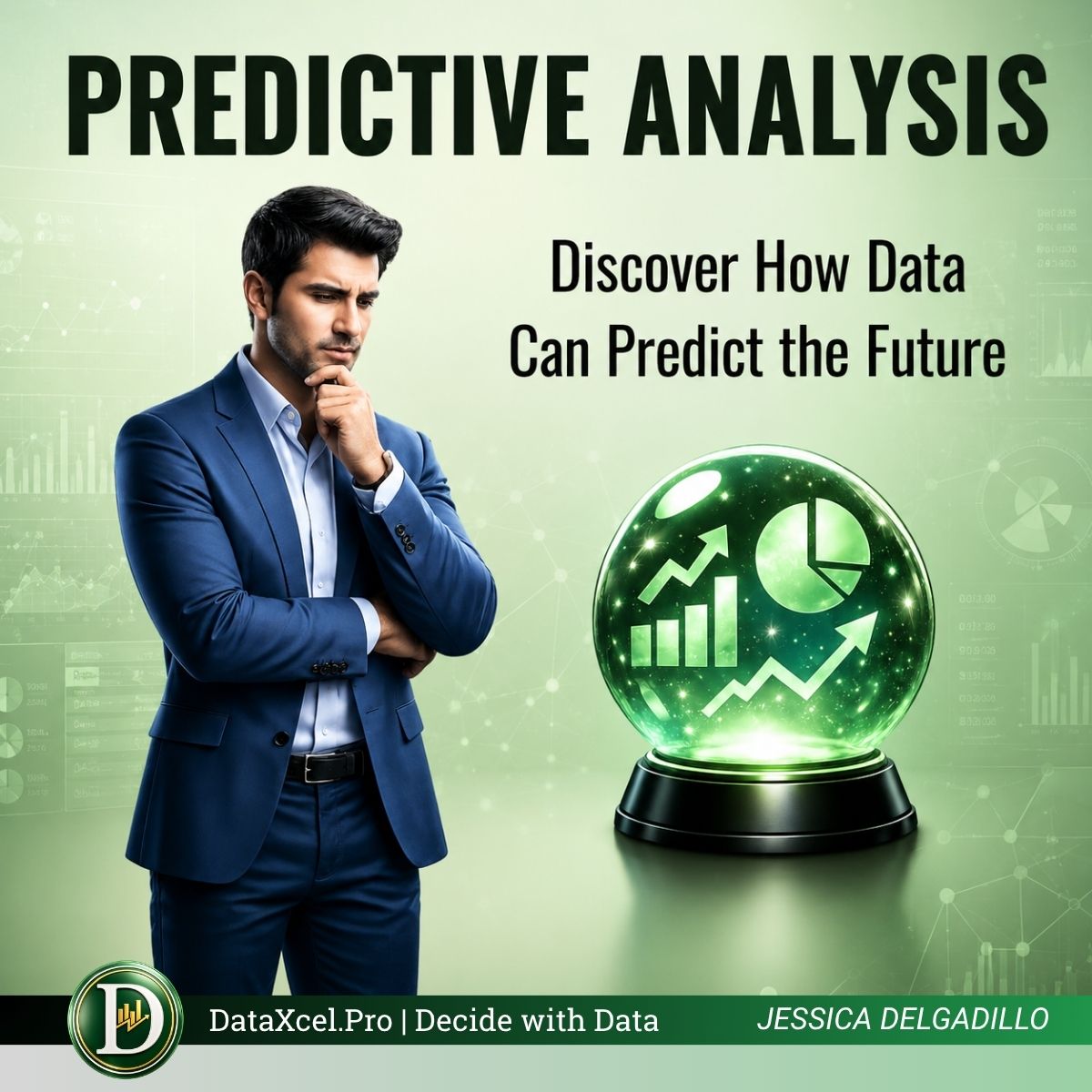
Which products will be in higher demand? Which customers might leave? When could a piece of equipment fail?
The answers may already be hidden within your company’s data.
Predictive analytics identifies patterns, anticipates future scenarios, and enables businesses to act before risks affect their operations.
It does not guess the future. It reduces uncertainty and transforms data into better decisions.
Predictive analytics uses historical data, statistical techniques, and machine learning models to estimate what may happen in the future.
It can help anticipate:
Predictive analytics does not replace human expertise. It turns it into evidence-based decisions.
Its true value lies not only in generating a prediction, but in using that prediction to take timely action.
Data analytics can answer different questions depending on the level of insight required:
| Type of Analytics | Question It Answers | Example |
|---|---|---|
| Descriptive | What happened? | Sales decreased. |
| Diagnostic | Why did it happen? | Stockouts occurred. |
| Predictive | What could happen? | Demand could exceed available inventory. |
| Prescriptive | What should we do? | Increase replenishment before the peak-demand period. |
Predictive analytics connects what has already happened with what is likely to happen next, helping companies stop reacting too late and start anticipating change.
Although predictive models can vary in complexity, the process follows a clear sequence:
Data may come from sales, inventory, customers, production, maintenance, costs, delivery times, or other variables related to the purpose of the analysis.
Errors, duplicate records, inconsistent formats, and incomplete data must be corrected.
A prediction built on poor-quality information can lead to poor decisions.
Trends, seasonality, variations, relationships between variables, and recurring behaviors are analyzed.
The most appropriate method is applied, and its predictions are compared with actual results to evaluate accuracy.
Based on the estimated scenario, the company can adjust purchasing, inventory, campaigns, production, maintenance, staffing, or investments.
Data → Pattern → Prediction → Decision → Result
A prediction only creates value when it leads to a specific action.
Predicts: Demand, stockouts, and excess inventory.
Enables decisions about: How much to purchase, when to replenish, and which products to prioritize.
Impact: Fewer shortages and more efficient use of working capital.
Predicts: Purchase intent, campaign response, and potential customer churn.
Enables decisions about: Which customers to target, what message to use, and when to deliver it.
Impact: Higher conversion, retention, and profitability.
Predicts: The probability of failure based on equipment usage, condition, or behavior.
Enables decisions about: When to perform maintenance before a breakdown occurs.
Impact: Fewer unplanned shutdowns and greater operational availability.
Predicts: Production times, delays, demand, and capacity requirements.
Enables decisions about: How to allocate shifts, routes, and resources.
Impact: Less waste, fewer delays, and lower operating costs.
Predicts: Employee turnover, absenteeism, and training requirements.
Enables decisions about: Which preventive actions should be implemented.
Impact: Greater employee retention and improved organizational performance.
Predicts: Potential defaults, budget deviations, and financial behavior.
Enables decisions about: Where controls should be strengthened and resources adjusted.
Impact: Lower risk exposure and more timely financial decisions.
| Benefit | Business Value |
|---|---|
| Anticipation | Identifies risks and opportunities before they affect operations. |
| Evidence-Based Decisions | Reduces dependence on intuition and assumptions. |
| Resource Optimization | Improves the use of inventory, budgets, personnel, and capacity. |
| Loss Prevention | Reduces shortages, failures, delays, and cost overruns. |
| Measurable Results | Makes it possible to compare predictions with actual outcomes and continuously improve. |
You do not need to begin with a complex technological infrastructure. The right tool depends on the volume of data, the business objective, and the company’s analytical capabilities.
Excel is a practical option for getting started with:
Power BI makes it possible to integrate information, visualize trends, identify patterns, and present forecasts through dynamic dashboards.
Python is suitable for automating analyses, processing large volumes of information, and building more advanced statistical or machine learning models.
ERP platforms and other business systems centralize sales, inventory, procurement, production, and financial data, creating a stronger foundation for predictive analysis.
The best tool is not necessarily the most advanced one. It is the tool that transforms reliable information into a useful decision.
A prediction should be evaluated before it is used to make business decisions.
The following factors should be considered:
A prediction is not a certainty. It is a probable scenario built from the information currently available.
The first step is not choosing a tool. It is asking the right question.
You can begin by analyzing:
Then:
Starting with a specific business problem makes it easier to demonstrate results and build a data-driven decision-making culture.
Historical data does more than explain what has already happened. It can also reveal signals about what may happen next.
Predictive analytics helps companies make better purchasing decisions, prevent risks, optimize resources, and identify opportunities before they become obvious.
It does not replace human judgment. It strengthens it with information.
The value of data lies not only in the past it explains, but in the future it helps anticipate
DataXcel Pro
Start with a relevant question, use the data you already have, and transform every prediction into a measurable decision.
DataXcel | Data That Drives Your Success